Sunday, May 5, 2013

Projects vs PBL


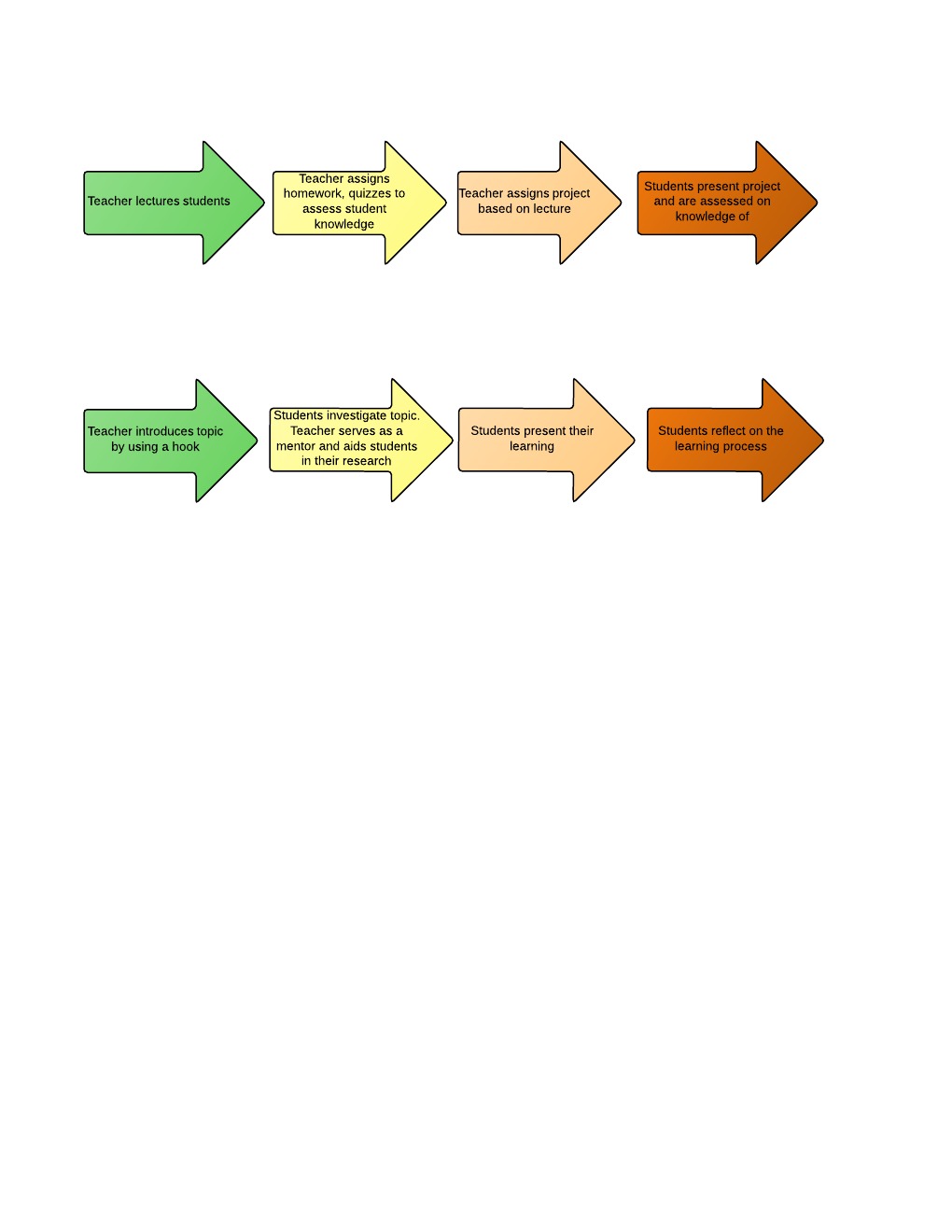
In these flowcharts I am showing the differences between doing "projects" vs. project based learning.  


 In a classroom where the students do "projects" the teacher lectures the students regarding a topic and their project reflects only their knowledge at the end of the unit.


In  a PBL classroom the teacher acts as a mentor or a guide and helps the students understand the topic through their own research.    The students then reflect on their learning after the project is done.


Watching the video and creating these flow charts made me  reflect on on the PYP projects we do in 4th grade, and whether they are "just projects" or if we are actually leading PBL units of inquiry.  For example, on our leader unit we first discuss what are the differences between a positive and a negative leader, and then we assign leaders for the students to research... Would it be better if we assigned the project first and then had the kids decide if their leader is positive or negative based on their findings?  Thoughts?

Sunday, April 28, 2013

Project Based Learning

Project-Based Learning is, in my opinion, a way in which students learn by doing.  The teacher will set the guidelines, and expectations, but will not "lecture".  Instead, the teacher serves as a mentor, while the students experiment and look for the best way to meet the expectations.  I think PBL is a great way to engage kids in their learning.  By giving the students the autonomy to work in a project and allowing them to "get their hands dirty" the kids are more interested in learning.  

In 4th grade we have different examples of project-based learning.  The opera, of course, is a huge project that the students work on.  The students write, produce, and perform a "musical" while applying different concepts they have previously learned.  Likewise, in our nutrition unit the kids research different nutrients, and then present the nutrient to their classmates.  The kids were then asked to develop a balanced meal, and present it to a group of "guests".  The guests asked the students questions regarding the nutrients in their food, and why did they decide to "pair it" with the other food in the meal.

 One of the biggest problems I see is that not every kid puts the same effort on their projects.  Making sure that everyone is working (if it's a group project) and that they are all doing their best is very important.  

Saturday, October 6, 2012

Infographic


 In a group of 5 we created an infographic comparing environmental effects on the world.  We chose 5 different countries, and found information to compare how those countries affect the environment.
We separated into two main groups.  We had 3 people do the research, and create the infographic, and 2 of us looked for the pictures and created the Imovie.
I think the infographic would help explain in a visual way how the different countries affect the world.  The students will benefit from their teacher using an infographic because it is very easy to understand and it can help them come up with good interesting questions.

Thursday, October 4, 2012

Cat World


Miau Publisher is proud to present Cat World, a magazine that will forever change a cat lover's life.  This no non-sense magazine offers in-depth articles about your loved feline, offers advice from our kitty experts, and tells hear-breaking stories written by our readers, devout cat lovers. The readers should remember that while cats are very independent, they also need tender love and care.  
The magazine does not only have interesting articles, but it also has artistic pictures of cats.  This makes it a little different from other cat magazines.
The headlines contrast with the sepia colored picture, but are still simple enough to not affect the picture.
The picture on the cover shows a beautiful, loving cat.


Representation, Bias, and Stereotypes

Representation, Bias and Stereotypes


Stereotype
Pantene Pro-V treatment
The girl in the ad has beautiful hair.  She has obviously gone under some intense hair styling treatment, and probably had to sit with a hair stylist for hours.  Her hair looks breezy, shiny and with lots of body. When you see the ad, and read catch frase (Don't Cut It!) you wonder if you use that treatment, your hair will look as beautiful as hers.  The stereotype I found in this ad is that, if you use the treatment, you will look as radiant as she does.


Bias
Partido Verde Ecologista
There are two "characters" in this ad.  There is a mean, pharmacist who does not help out the poor, helpless woman.  The pharmacist is heartless, he does not care about the woman's problems.  The woman is heartbroken.  How will she ever save her kids.
The ad then tells you to turn the page.
When you turn the page, you get a picture of presidential candidate Peña Nieto.  His campaign promised free medicine stamps for everyone. In the picture Peña Nieto is smiling (and wearing the political party colors) and seems secure of himself.
The bias in this ad is that he is only showing this side of him.


Representation
Huggies UltraConfort


This ad "shows" you how easy it is to change a diaper if you use Huggies UltraConfort.  The ad shows different steps to using this special kind of diaper.  It does not show all of the steps. 

Codes


Technical Codes that were in the movies were:

Cloudy with a Chance of Meatballs
Symbols
The video was very colorful and looked cartoonish. The setting was made out of food, and it looked very appealing.  
Technical Codes Jr
The video is 2 dimensional, and the camera is zooming in and out to the different food groups/important characters.

A Series of Unfortunate Events
Symbols
The video is dark and gloomy. It uses grays, black, and green. Visuals such as thorns, shadows, and swirls to portray confusion, sadness, or fear.
Technical Codes Jr
The video has quick transitions, and does a lot of zoom in/ fade outs that keep the viewer interested.

Technical Codes that were in the TV Commercials were:

Extra Chewing Gum

Symbols
Uses food known to the general public as food that makes your breath smell, as the "bad boys" that gum will stop. 

Catch Phrase
"Eat Drink Chew... Extra"- Eating and drinking are necessities, by putting Chewing Extra it makes it sound like it's also something you need to do.
Uses popular song "Bad Boys", and changes the lyrics to fit the commercial.

Nolan Cheese

Symbols
The mouse trap as an obstacle for the mouse
The cheese as something desired

Technical Codes Jr
There is a blackout after Rocky's theme song, making it sound like something dreadful happened.

Catch Phrase
"Seriously Strong"- Not only talks about the strength of the cheese, but also represents the strength of the mouse in the video. The mouse overcomes the trap by
Music Selection- "Rocky Theme Song" "The End" would represent giving up, "Eye of the Tiger" is the fight, and the will to get better-stronger

Magazine Ads

Baconator

Symbols
The size of the burger takes over the entire ad. It makes it look "strong" and "big". The ingredients are in small print

Writing
Colorful writing
Buzz Words- "Small is Better- Works only for Gadgets" using the word gadget makes it more appealing to the public.

Farm Fresh

Symbols
The black and white city contrasts with the bright orange carrots.


Writing
Buzz words- farm fresh


Reflection
I think knowing how to identify codes and symbols is really important because we are constantly bombarded by media. We need to know what movie trailers, tv ads, and magazine commercials are trying to tell us.  
For example, when we saw the trailer for "Cloudy with a Chance of Meatballs" we thought that the introduction would make the people watching the movie crave food- particularly junk food.


Lesson Plan

Objective: How are food marketers crossing the line between advertising and entertainment to engage young consumers, and why does this concern children’s consumption in daily life? To what extent are product-related games, quizzes and apps making children both recipients and tools of marketing? In the lesson below, students look at various forms of advertising, then keep logs of the ads and other branded content they encounter over the course of a week. The students will reflect on their experiences researching and how they will become different consumers.

Materials: Computers with Internet access, projector, links to examples of advertisements and commercials. (see links below)

Warm-Up: Display the following three-question quiz on the board/projector.

1. It is conservatively estimated that children influence more than $_______________ in food and beverage purchases each year in the United States.
a. 10 million
b. 50 million
c. 50 billion
d. 100 billion

2. In February, the McDonald’s sites HappyMeal.com and McWorld.com received a total of ______________ visitors, around half of whom were under 12.
a. 7,000
b. 70,000
c. 700,000
d. 7 million

3. General Mills’ Lucky Charms site, with virtual adventures starring Lucky the Leprechaun, had __________ visitors in February.
a. 27,000
b. 57,000
c. 157, 000
d. 227,000

(correct answers: 1. d; 2. c; 3. d)

Reflection: Have students answer the questions with table groups. Ask students if they find any of these numbers surprising.

Lesson and Activities:

Activity A
A. Show the movie title sequence.
Ask the question, "What are the feelings you had while watching the movie? List them all down on the board or chart paper.

Lemony Snicket's A Series of Unfortunate Events

B. Show the magazine ad. Ask the same question, "What were the feelings you had while looking at the ad? List them all down on the board or chart paper.

C. Show the Magazine ad again and play the movie at the same time. Alternately show the ad and the movie making sure that you give an ample amount of time using the music from the movie as a background music to the magazine ad.
Ask the same question again, "What were the feelings you had while watching both at the same time? List them all down on the board or a piece of paper.

D. Compare your lists and discuss the similarities and differences.

E. Show the TV commercial

Wrigley's Extra Chewing Gum

Ask the students to describe the commercial. Ask the question, "What is the message of this TV commercial? Is it effective? What are the benefits of using images and music altogether to relay a message?

F. Do steps A-E for Activity B with the following media samples.


Activity B
Movie Title Sequences:
Cloudy With A Chance Of Meatballs

Magazine Ad:

TV Commercials:
Nolan Cheese Commercial
G. Compare the results of Activity A and Activity B.

H. Show the Wendy's ad again and play the Cloudy with a Chance of Meatballs movie at the same time. Ask the question: How did your feelings change about the magazine ad? List down answers on the board or chart paper and discuss the differences from the list made in Activity A.
Activity C
Poll the class. Ask for a show of hands for each of these questions, and tally responses on the board:

  • Have you ever played a game, taken a quiz or used an app related to a food, drink or other product?
  • Have you ever “liked” a product on Facebook? Ask some students to share which products they have “liked” or tagged online. List them on the board.

What do you notice about the list? Have you asked your parents to buy these products? Were you already consumers of these products?

Reflection:
Look around the grocery store. How does the junk food aisle differ from the produce section?

What are some of the marketing techniques you see in the grocery stores?  Are they efficient?

What restaurants are you attracted to at a food court and why?
How do you think things are different today than they were when ads were only in print, display, radio and television?
Wednesday, October 3, 2012

Chip Kidd- Book-Cover Designer Extraordinaire

I loved listening to Chip Kidd talk about the importance of book covers.  Many times i've bought books based on the picture on the front.  In some particular cases, where they have different covers for different parts of the world, i've seeked for a particular version of the book just for the cover.
There is something "romantic" about a book (very much as there is something romantic about getting a letter on the mail, compared to getting an email).  The smell, the yellowish pages, being able to underline particular phrases or make comments on the side, and most definitely, the cover.
A book cover calls me.  It invites me to an imaginary world.  In cases where the book has a picture on the cover, it's the first impression I have of a new place, of a new story.

"The Great Brain Suck"
This book has a great cover.  The cover shows what looks like a black hole, a great image to portray something that is getting "sucked in".  The title of the book is white and right in the middle, where the black hole would be found.  The title contrasts with the other colors in the cover- red and black- making it easy to see it.  The cover makes you want to look inside the book, and see what the "black hole" has pulled in.

"Smothered in Hugs"
I liked this book cover as well.  When I think about big smothery hugs I immediately think about bear hugs.  The picture definitely portrays being smothered with hugs.  I feel that with a picture like the bear in the front, you need very simple type and colors.  Any other colored letter would get lost with the bear.

"Ugly Man"
Ha! A pickle to talk about an ugly man. I definitely want to open the book and see what it is about.  The picture is funny, and it makes me think the book will be funny as well.  I like the white background and black type.  It makes it very neat and organized next to the picture.